
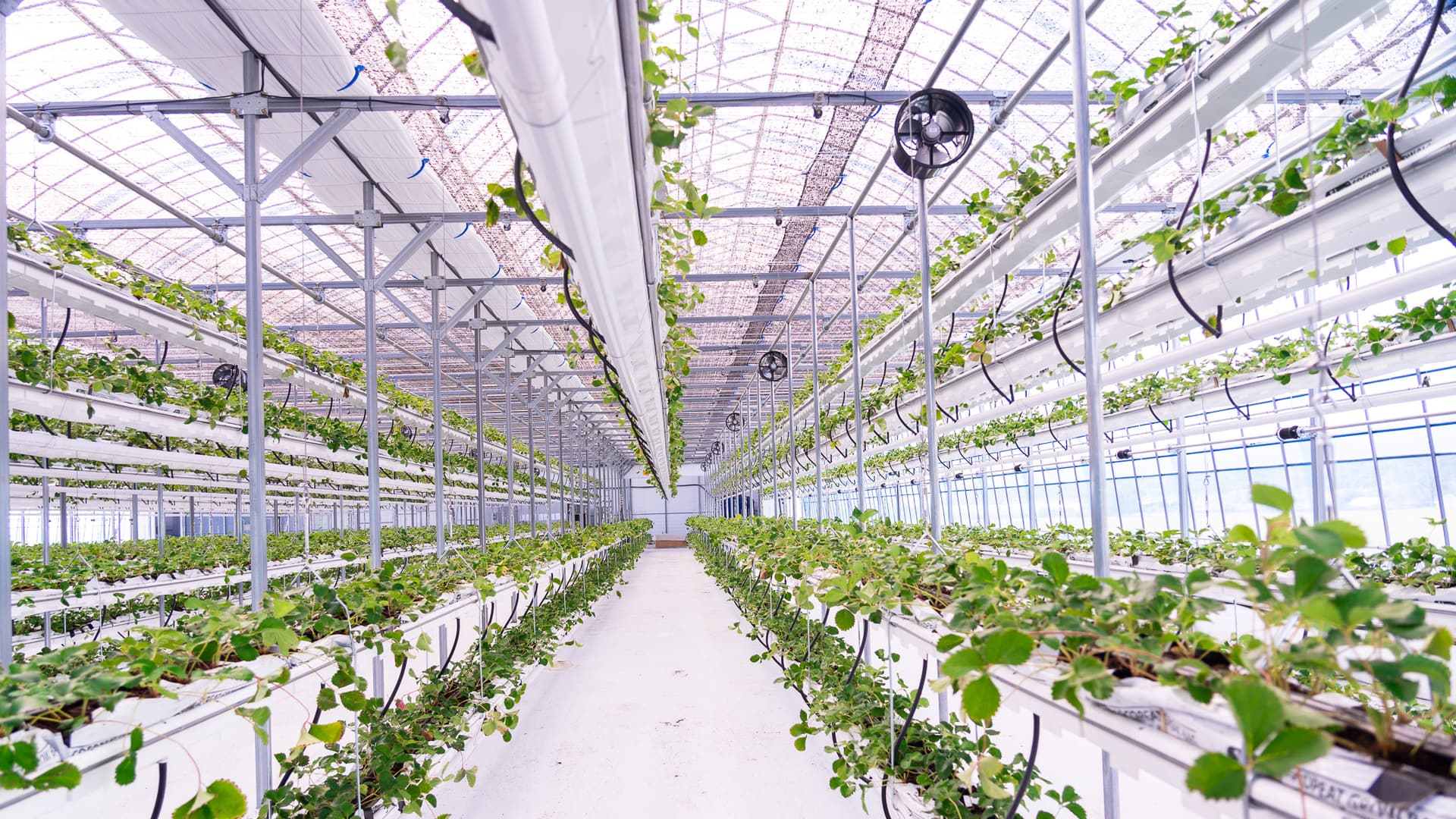
01 · PLASTIC GREENHOUSE
Behind the K-strawberry,the Korean-style plastic greenhouse
Nearly all the Korean strawberries on the shelves of Asia's premium stores are grown in plastic greenhouses. These structures withstand scorching heat, monsoon rains, sub-zero winters, and heavy snow all in a single year, and they have evolved to manage the crop environment with systems that open, shade, and cover. Here we explain how they are built and how they work, and we build them to suit your local climate.
K-FOOD
The Korean Wavehas reached the table
Interest in Korea that began with dramas and music is now extending to food. In 2025, Korea's agri-food exports topped $10 billion for the first time. Strawberries lead Korea's fruit exports, accounting for 63% of fruit exports in the first half of 2026. And 99% of those strawberries are grown in greenhouses.
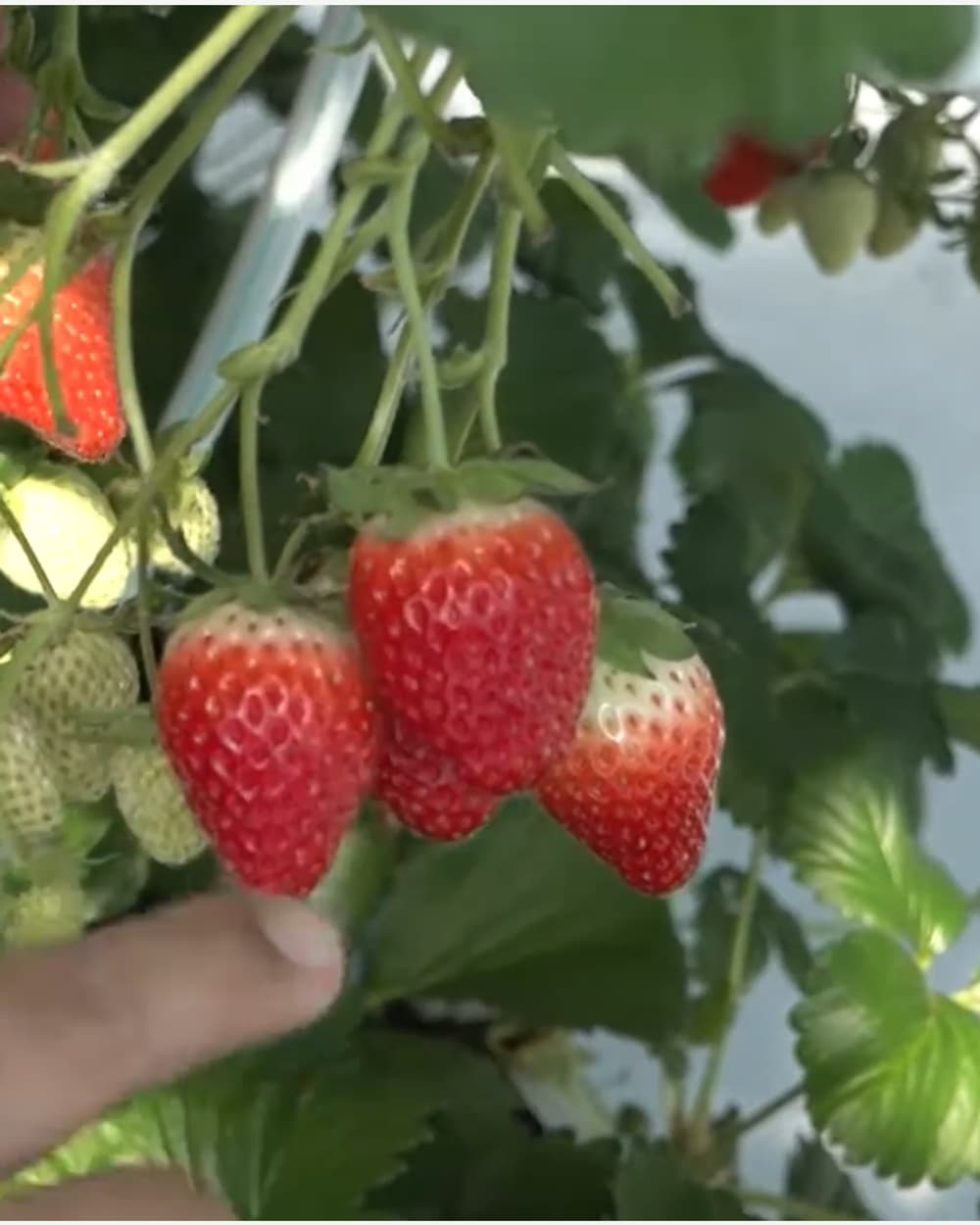
In midwinter, when it's freezing outside,
Korean strawberries ripen red in plastic greenhouses
- 16×
Growth in Korean strawberry exports over 20 years: from $4.4 million to $72 million (2005 → 2025)
- 6 in 10
Strawberries make up 6 in 10 of Korea's fruit exports. By export value, first half of 2026
- Thailand · Singapore · Vietnam
The top buyers of Korean strawberries. $46.7 million from these three countries alone (2025)
- 99 in 100
Nearly all Korean strawberries are grown in greenhouses: 99% by cultivated area (2023)
Sources: Ministry of Agriculture, Food and Rural Affairs (MAFRA), agri-food export results (January 2026) · Korea Customs Service, fruit export trends (July 2026) · MAFRA, vegetable production statistics (2023)
THE GREENHOUSE
The very greenhousewhere Korean strawberries grow
Outside it's below freezing, yet inside the greenhouse strawberries ripen red. By day, the vents open to release heat; by night, thermal blankets cover the house to hold in the warmth. This daily routine continues from November through the following spring, producing the winter strawberries Asia waits for. Light and quick to build, yet precise in managing the environment crops need: that is the Korean-style plastic greenhouse.
Harvests beyond the natural season
Harvest timing is set by the environment inside the greenhouse, not the weather outside. Ship in midwinter, when strawberries are scarce, and extend the growing season.
Farming less at the mercy of the weather
The structure has been refined through year after year of heat waves, monsoon rains, cold snaps, and heavy snow. It reduces weather-driven swings in output so you can harvest as planned. Standardized parts make film replacement and repairs simple.
Start small, grow big
With a lower upfront investment and a shorter build time than a glass greenhouse, you can start your first cropping season quickly. Then grow the farm by adding irrigation, ventilation, and nutrient solution automation and the 2-Tier Hanging Bed in whatever order you need them.
BUILT FOR FOUR SEASONS
Four seasons of weather,one greenhouse to withstand them all
Korea goes through completely different climates within a single year. Summer brings heat above 30℃, monsoon rains, and typhoons; winter brings sub-zero cold and heavy snow. So the Korean-style greenhouse evolved to open up when it's hot, cover up when it's cold, and stand up to rain, wind, and snow.
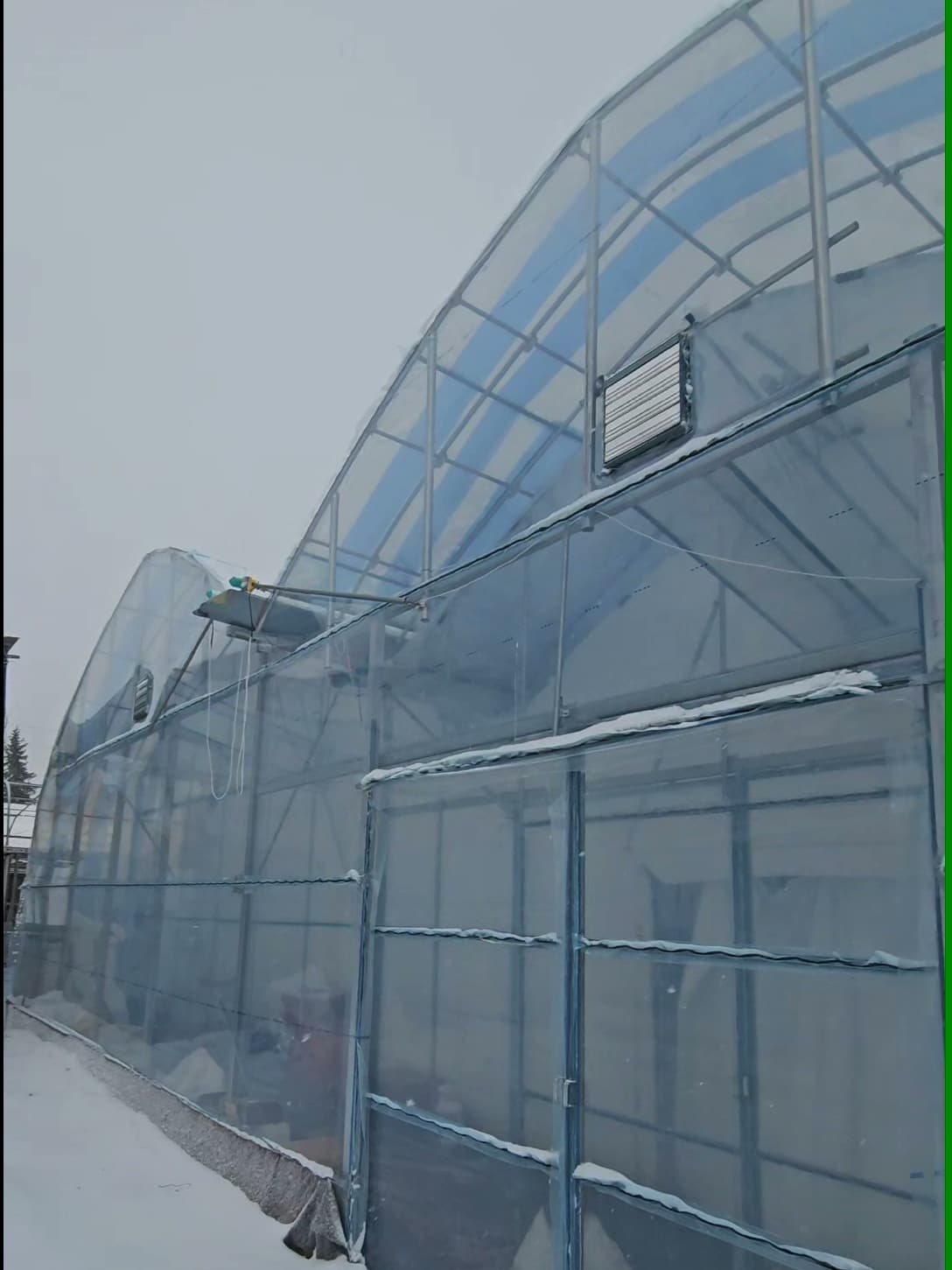
Spring
Wide day-night temperature swings
Vents open by day to release heat, then close and cover up at night to hold in the warmth.
Summer
Heat · monsoon rains
Roof and side vents open, and shade screens block the sun. Gutters carry downpours away from the house.
Fall
Typhoons · transplanting
In strong winds, the vents close and the frame holds firm. Temperatures are adjusted to help newly transplanted seedlings take root.
Winter
Sub-zero cold · heavy snow
Layers of thermal blankets wrap the house, and the disaster-resistant frame carries the weight of the snow.
Government disaster-resistance design standards
Since 2007, Korea has published region-by-region snow load and wind speed standards that plastic greenhouses must withstand. In October 2025, the standards were raised for 22 regions to reflect damage from heavy snow and strong winds, and 44% of Korea's plastic greenhouses have already been converted to disaster-resistant designs (2023).
Gimje, Jeonbuk, home to our company-operated farm, falls in the highest snow load category (40 cm or more), and its wind speed standard was also raised in 2025. We run our greenhouses there every cropping season, on land held to the strictest standards.
Source: Ministry of Agriculture, Food and Rural Affairs (MAFRA), press release on the revised Disaster-Resistance Design Standards for Horticultural and Specialty Crop Facilities (November 3, 2025)
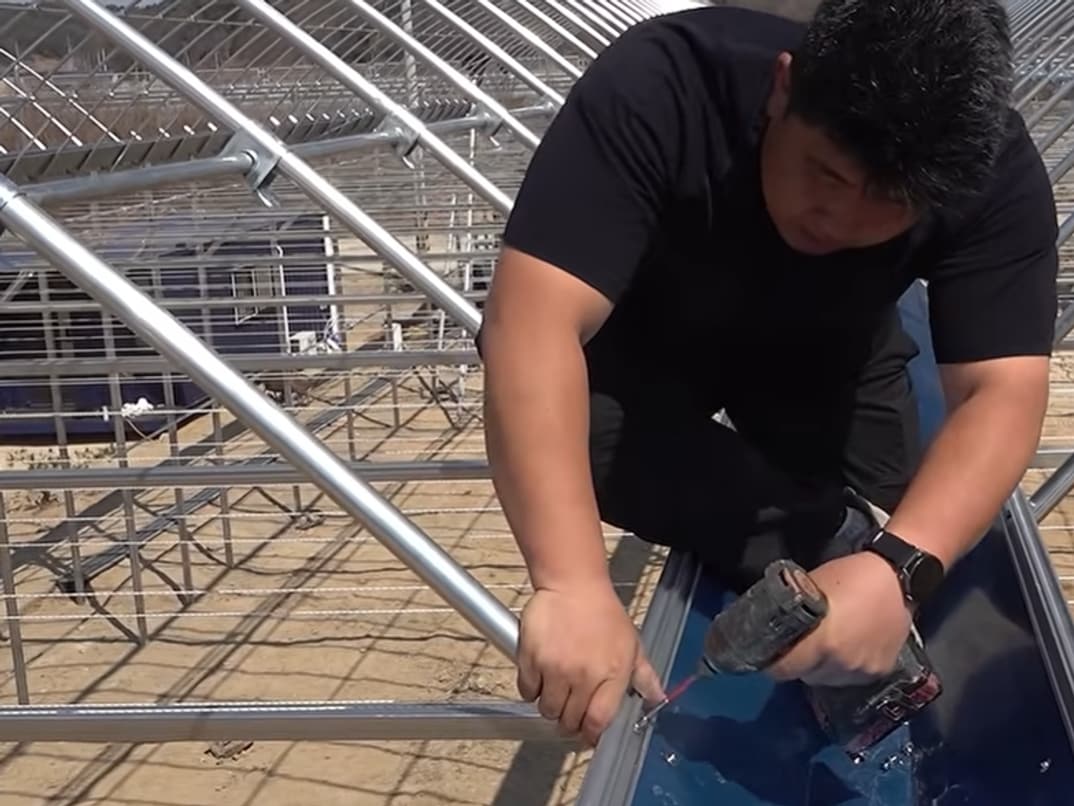
CASE · ONTARIO, CANADA
A greenhouse shipped from Korea,a first harvest in Ontario
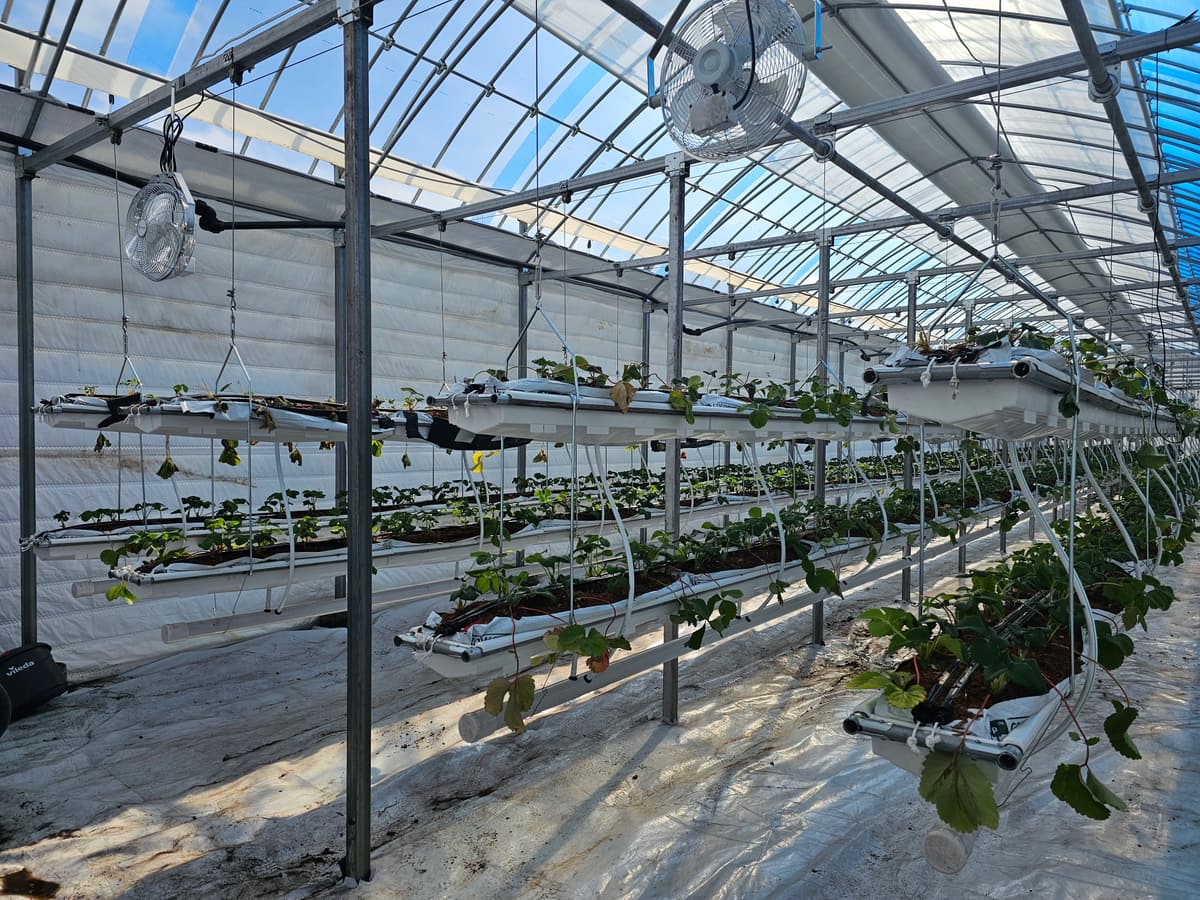
Near Toronto lies a region of long, snowy winters. We shipped materials from Korea, built the greenhouse, and installed the 2-Tier Hanging Bed and Dolsoe. Then we harvested the first strawberries from that greenhouse.
- Location
- Ontario, Canada (near Toronto)
- Facilities
- Korean-style plastic greenhouse · 2-Tier Hanging Bed · Dolsoe Smart Farm
- Materials
- Shipped from Korea, built on site
- First harvest
- 12 Brix sweetness · 27 g per berry
ANATOMY
The Korean-style greenhouseat a glance
From the outside it looks like a single layer of plastic, but inside are layer upon layer of systems for structure, drainage, ventilation, shading, insulation, and irrigation. Each one responds to the season and the time of day to create the environment the crop needs.
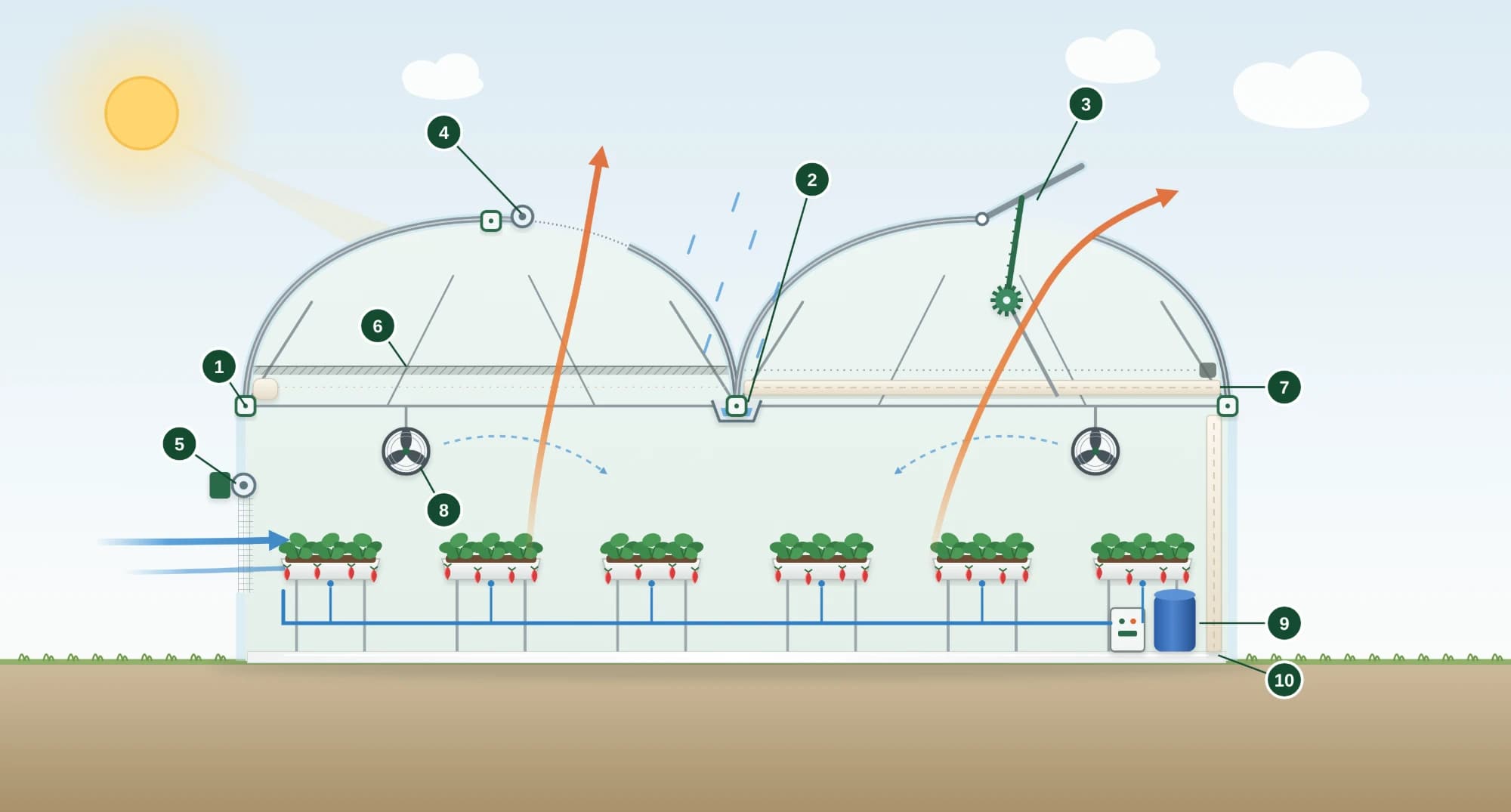
- 1Disaster-resistant frame and fittings
Pipes are joined and reinforced to bear wind and snow loads
- 2Gutter
Collects rain and snowmelt from the roof and drains it outside
- 3Roof vent · rack-and-pinion opening
Gears open the ridge vent to release the hot air that collects at the top
- 4Roof vent · roll-up opening
Rolls up the roof film for a wide opening that lets out heat and humidity
- 5Side vent · roll-up opening
Rolls up the side film to let in outside air
- 6Shade screen
Blocks strong sunlight to keep air and leaf temperatures from rising too high
- 7Thermal blanket
Covers the roof, sides, and front and back ends at night to keep heat from escaping
- 8Exhaust fan and circulation fan
Exhausts and circulates indoor air to keep temperature and humidity even
- 9Irrigation and nutrient solution line
Delivers set amounts of water and nutrients to every bed
- 10Floor tarpaulin
Covers the floor to block weeds and moisture and keep the work area clean
- +Panel work building and sash entrance door
Turns one end and the front of the house into a work area and entrance (not shown in the cross-section)
PART BY PART
What each part does,and why
A greenhouse's quality is decided less by what you can see than by what you can't. Here is what each part does and why it matters.
STRUCTURE
Structure · drainage
A frame that withstands typhoons and heavy snow, and a drainage system that handles rain and snow. Every system in the greenhouse depends on the frame holding firm.
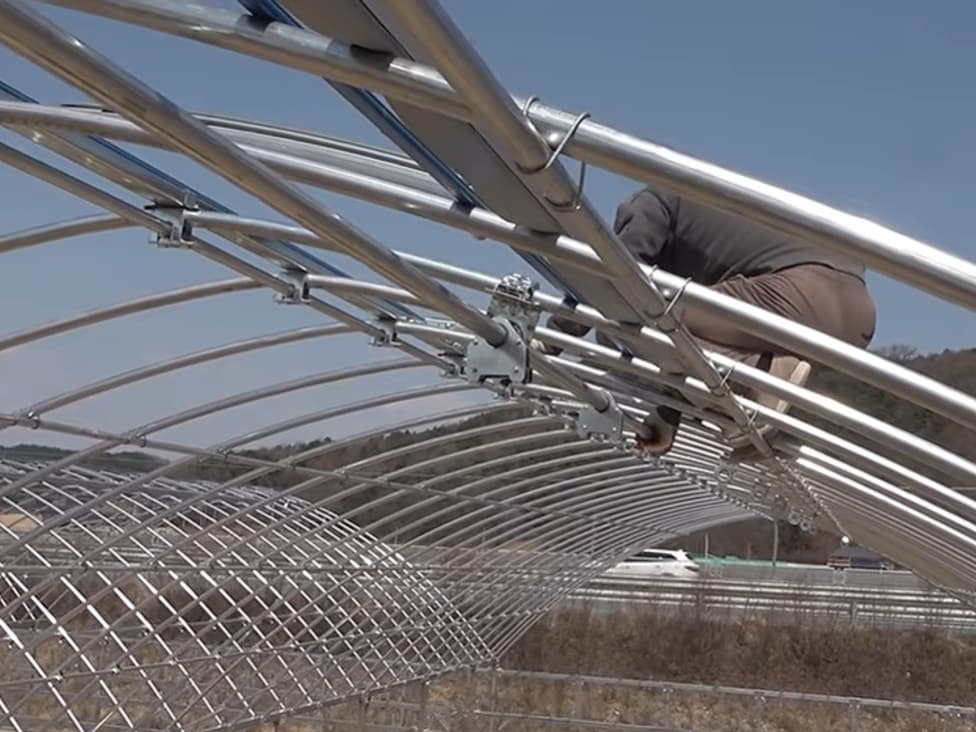
1Disaster-resistant frame and fittings
- Role
- Connectors that join and clamp pipe to pipe, together with posts and bracing, tie the greenhouse skeleton into a single structure.
- Why it matters
- Wind and snow loads bring a greenhouse down starting at its weakest joint. Disaster-resistant fittings reinforce these joints to the design load, so the whole structure shares the force as one. Because an uneven arch concentrates the load in one spot, we also built our own machine for bending pipe precisely.
Patent · Pipe bending device
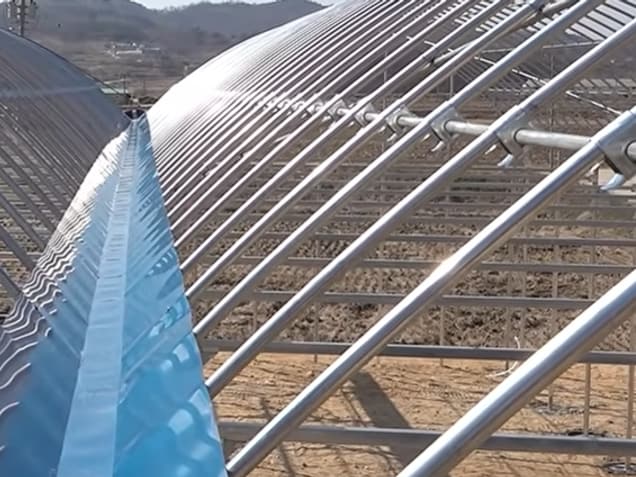
2Gutter
- Role
- Catches rain and snowmelt in the valleys between spans and at the eaves and carries it outside the greenhouse.
- Why it matters
- Water pooling on the roof makes the film sag and adds weight that strains the frame. Water that seeps inside raises humidity and invites disease. In a multi-span greenhouse, where many spans join under one wide roof, the gutter is the key component that completes the roof.
VENTILATION
Ventilation
Warm air rises and collects at the top, while cool air enters from below. Roof vents, side vents, and exhaust fans control this flow to set the indoor temperature and humidity.
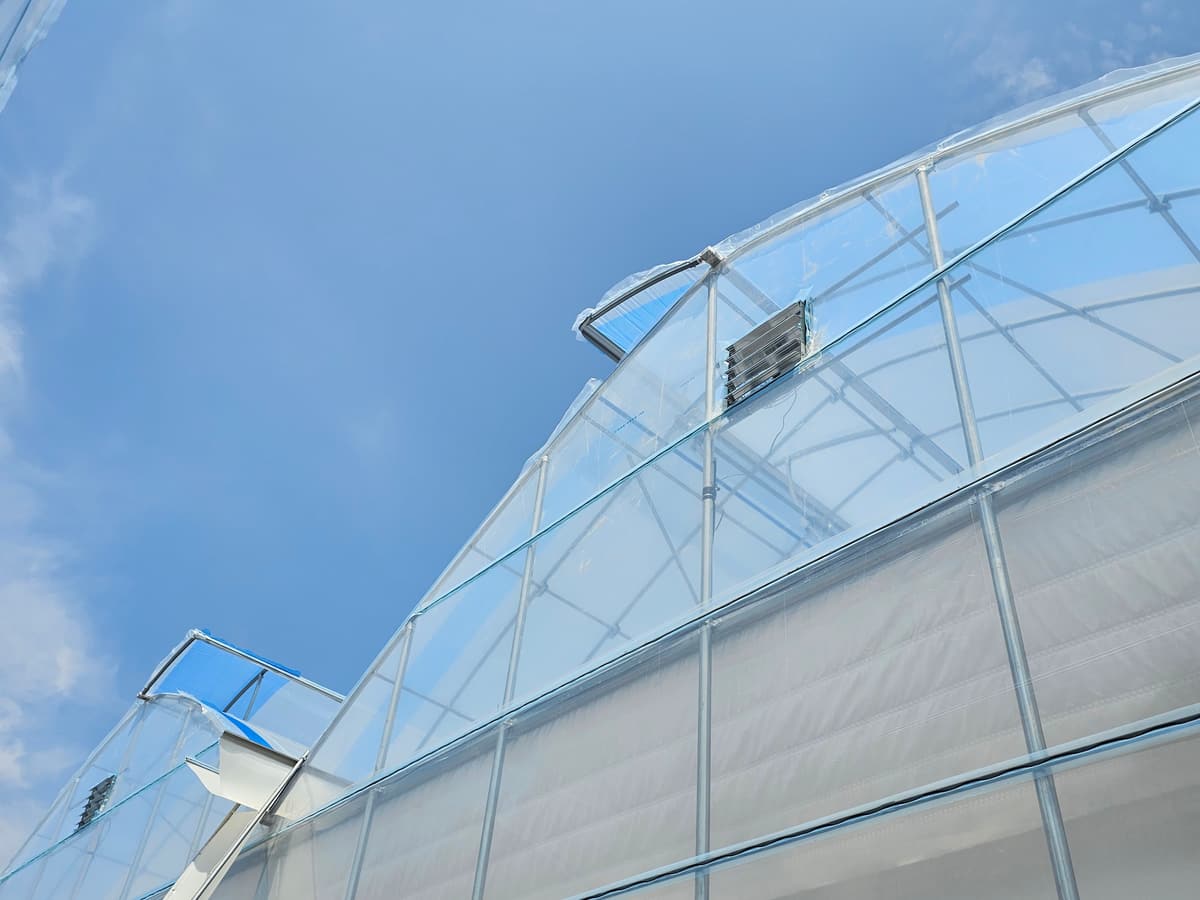
3Roof vent · rack-and-pinion opening
- Role
- A toothed bar (the rack) and a gear (the pinion) push the ridge vent open.
- Why it matters
- The hottest air in a greenhouse gathers just under the roof. Opening the highest point lets that hot air escape on its own, and outside air flows in to replace it. Rack-and-pinion vents stop precisely at the angle you want and hold firm so the wind can't rattle them.
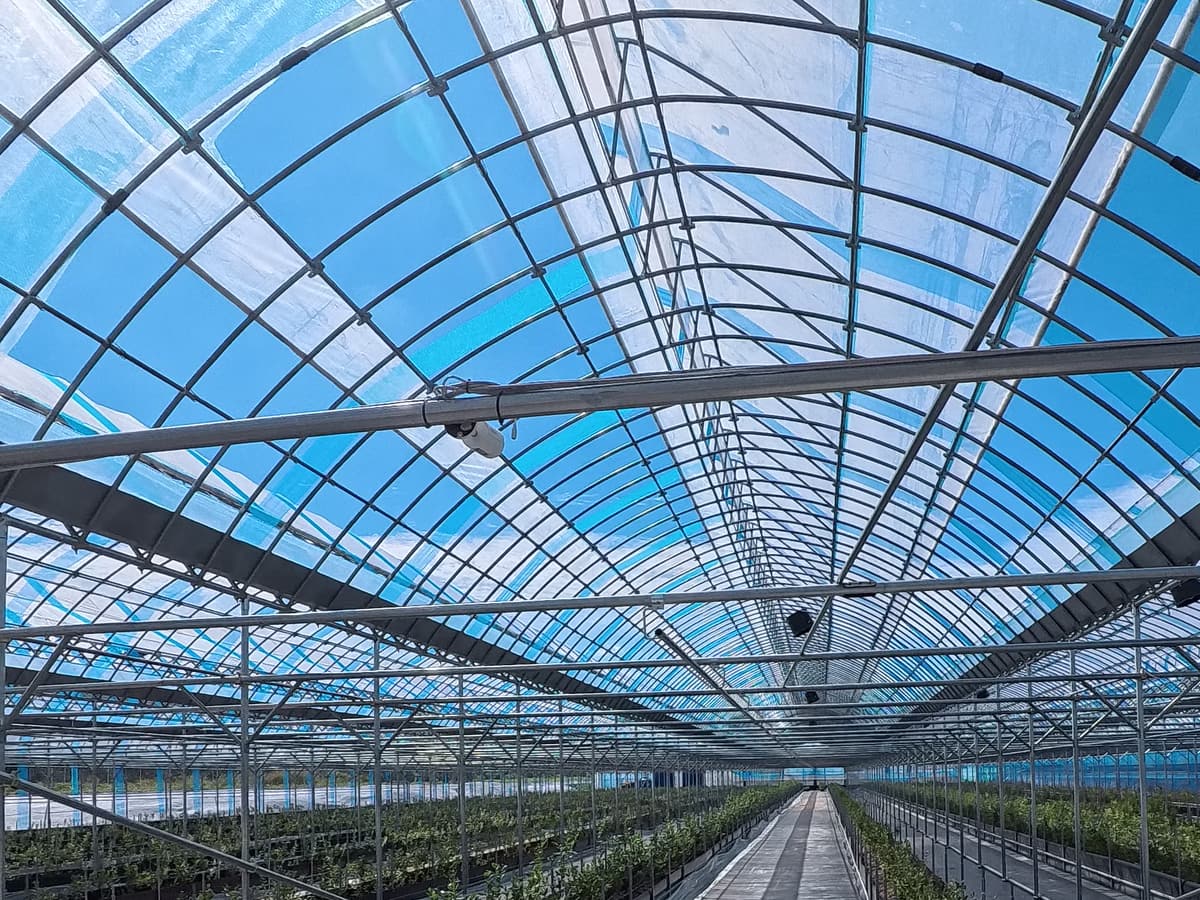
4Roof vent · roll-up opening
- Role
- A motor rolls up the upper roof film to open a long vent along the length of the greenhouse.
- Why it matters
- Opening the roof wide releases a large amount of heat and humidity at once, and the simple design is easy to add to existing greenhouses. Depending on the size of the house and local wind conditions, we choose rack-and-pinion or roll-up, or combine both.
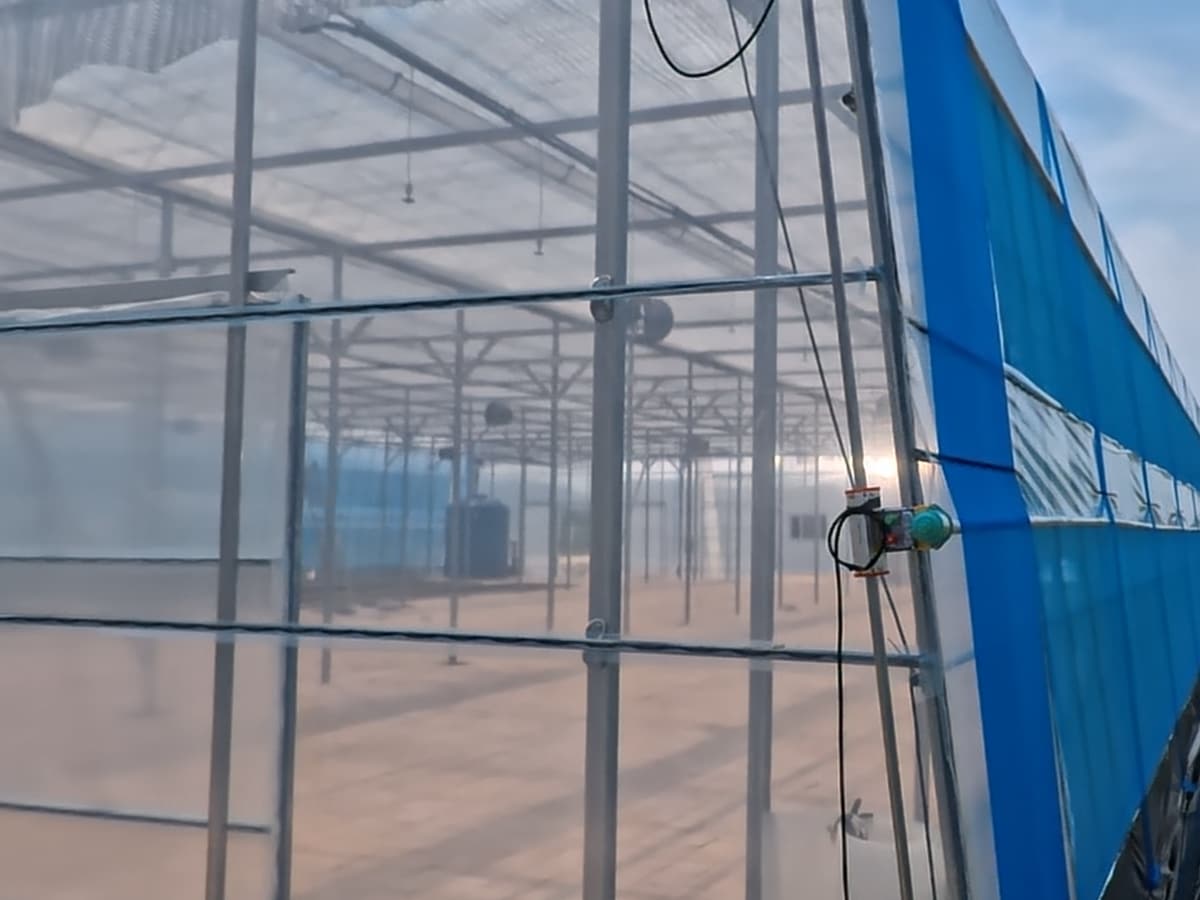
5Side vent · roll-up opening
- Role
- Rolls the side film up and down to open a path for airflow.
- Why it matters
- It works on the same principle as the roof vent. Bringing in outside air from below and releasing hot air above keeps air moving through the whole greenhouse. In rain or strong wind, it closes to protect the crop. We also patented a roll-up vent that reads exactly how far it is open.
Patent · Roll-up vent with roll-up encoder
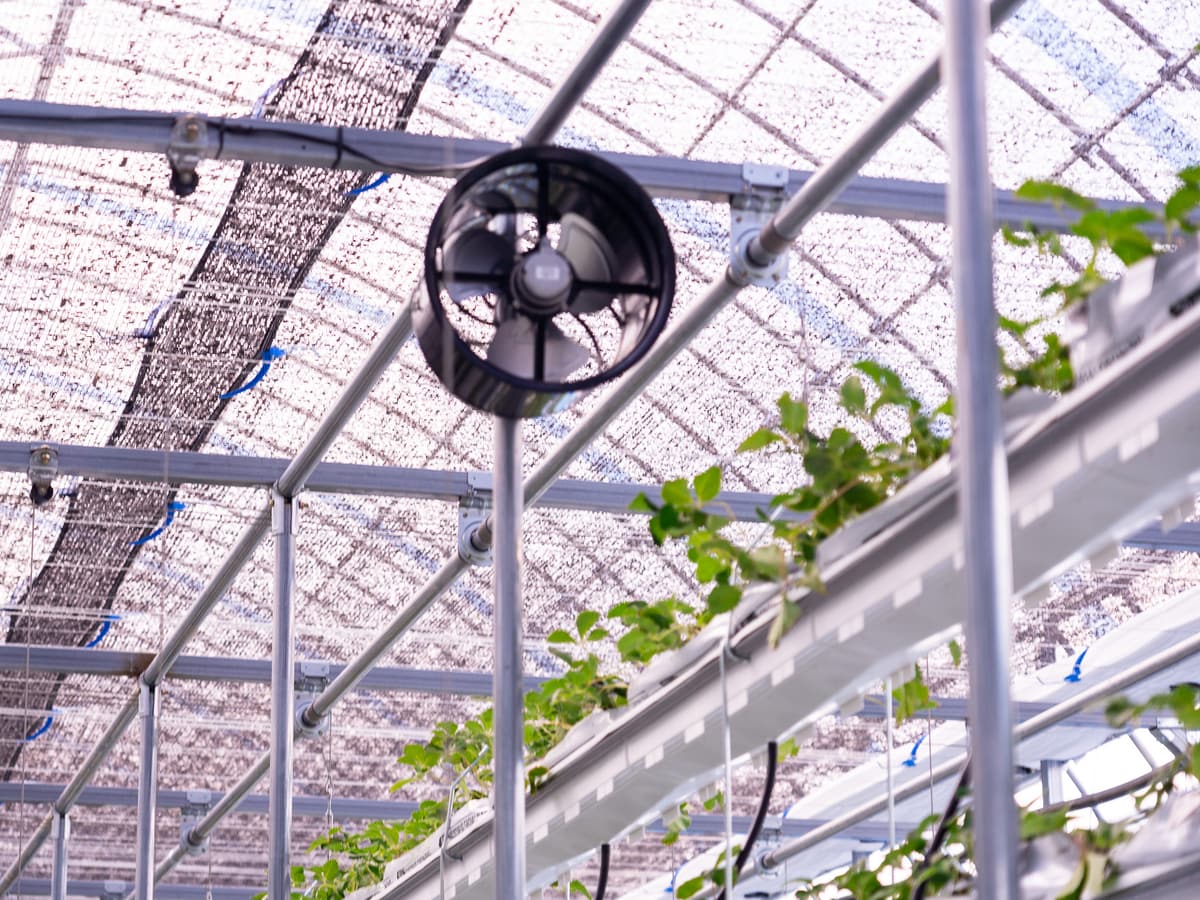
8Exhaust fan and circulation fan
- Role
- Exhaust fans push hot, humid air outside, while circulation fans mix the air evenly inside the greenhouse.
- Why it matters
- They keep the air from stagnating on still days and in winter, when the vents stay closed. When air stops moving, temperature and humidity vary from zone to zone even within the same greenhouse, and disease starts in the moisture that beads on the leaves.
SCREENS
Shading · insulation
In summer, shade screens cut light and heat; in winter, thermal blankets keep the heat inside. The greenhouse changes its covers with the seasons.
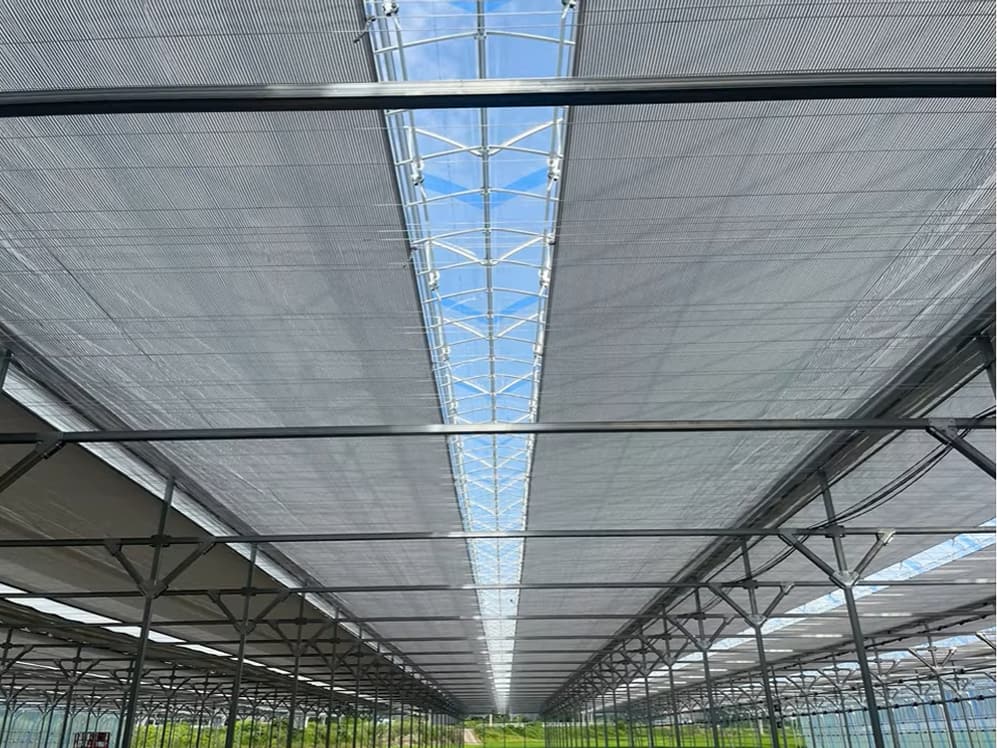
6Shade screen
- Role
- A shade cloth deployed beneath the roof. It cuts the intense sunlight and heat of midsummer.
- Why it matters
- When leaves get too hot, plants close their stomata and stop growing. The screen blocks harsh sun, then retracts on cloudy days and in the morning and evening to let in plenty of light.
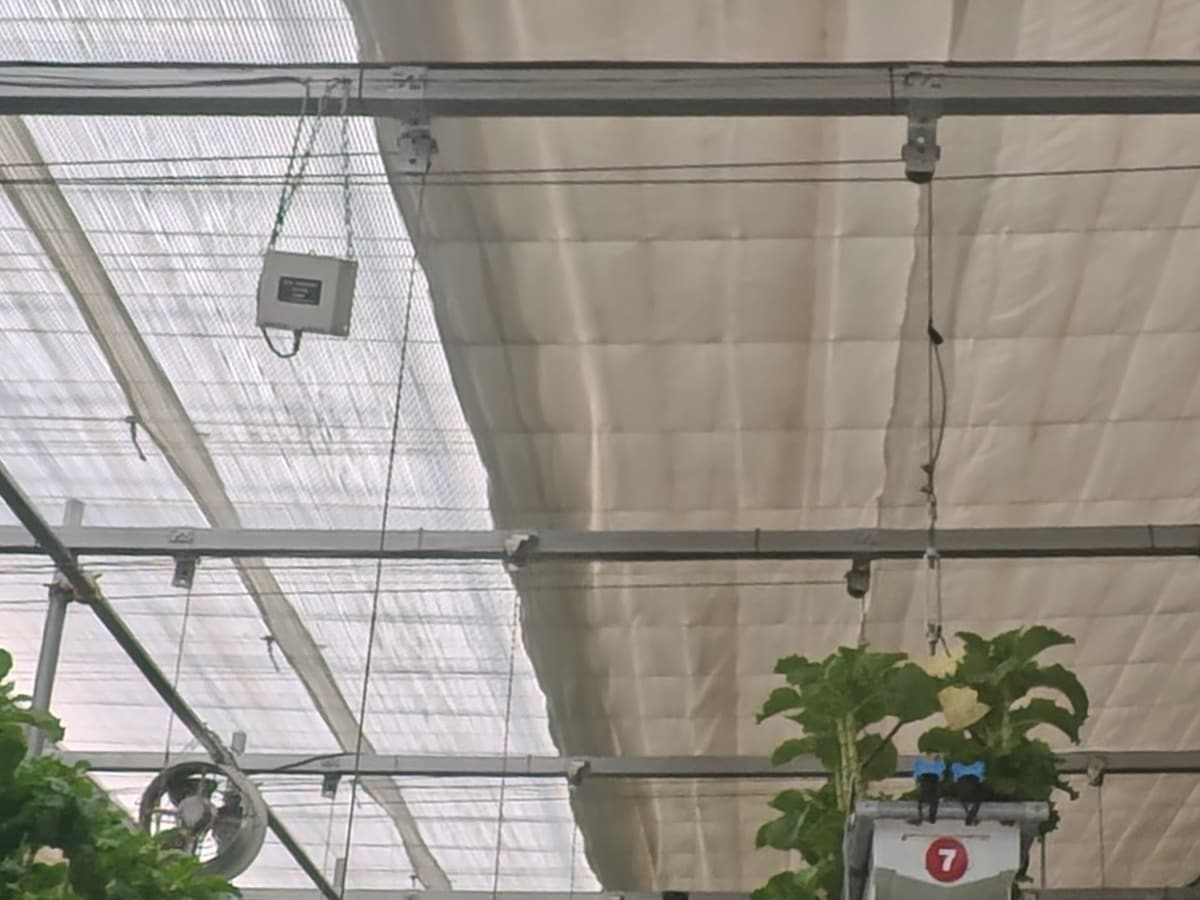
7Thermal blanket · roof · sides · ends
- Role
- At sunset, thick thermal screens wrap the roof, both sides, and the front and back ends, sealing the greenhouse with an extra layer.
- Why it matters
- On winter nights, most of a greenhouse's heat escapes through the roof and walls. Covering all five surfaces holds the nighttime temperature while cutting heating costs. In an analysis by the Rural Development Administration (RDA), highly insulated multi-layer thermal screens reduced heating costs by more than 50% compared with no screen at all.
FEEDING
Irrigation and nutrient solution
Water and nutrients are delivered in set amounts at set times, not by guesswork. Even feeding leads to an even harvest.
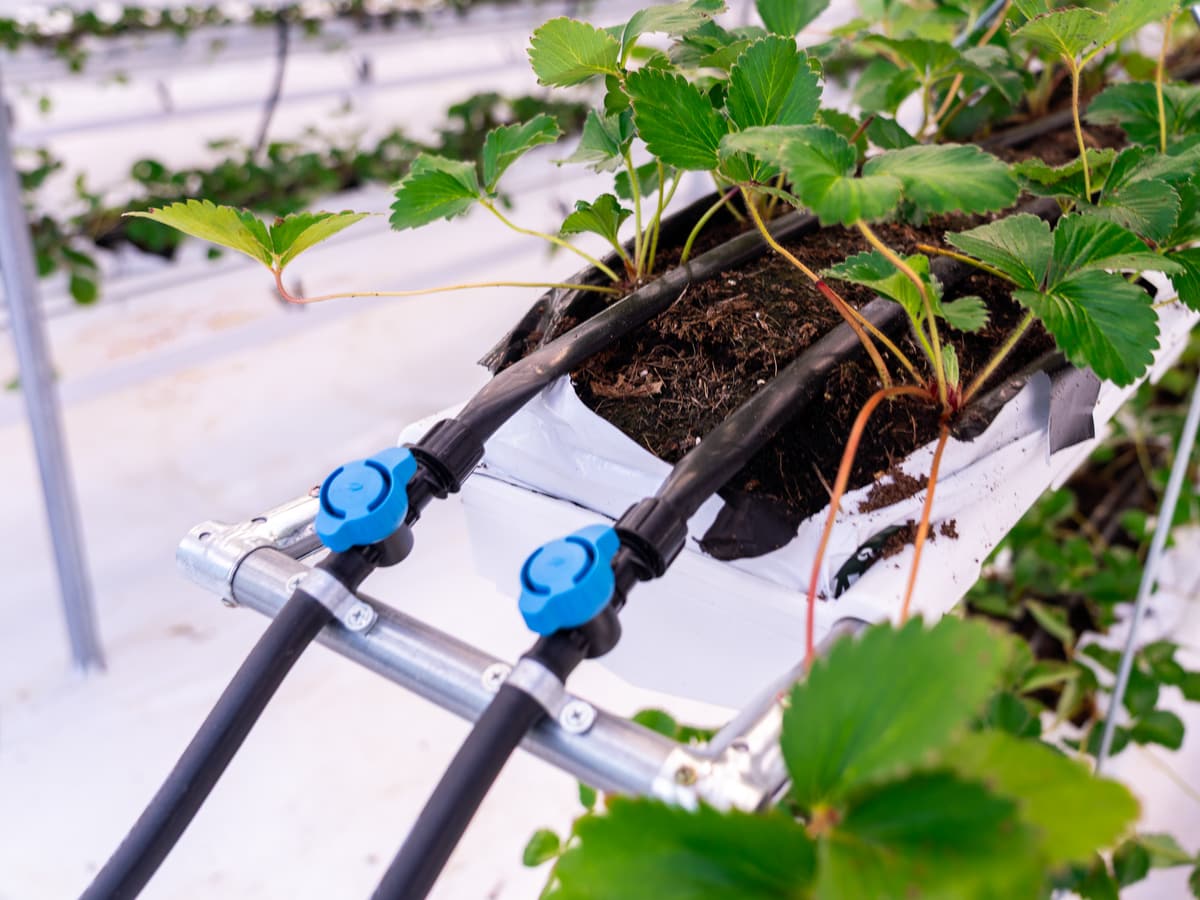
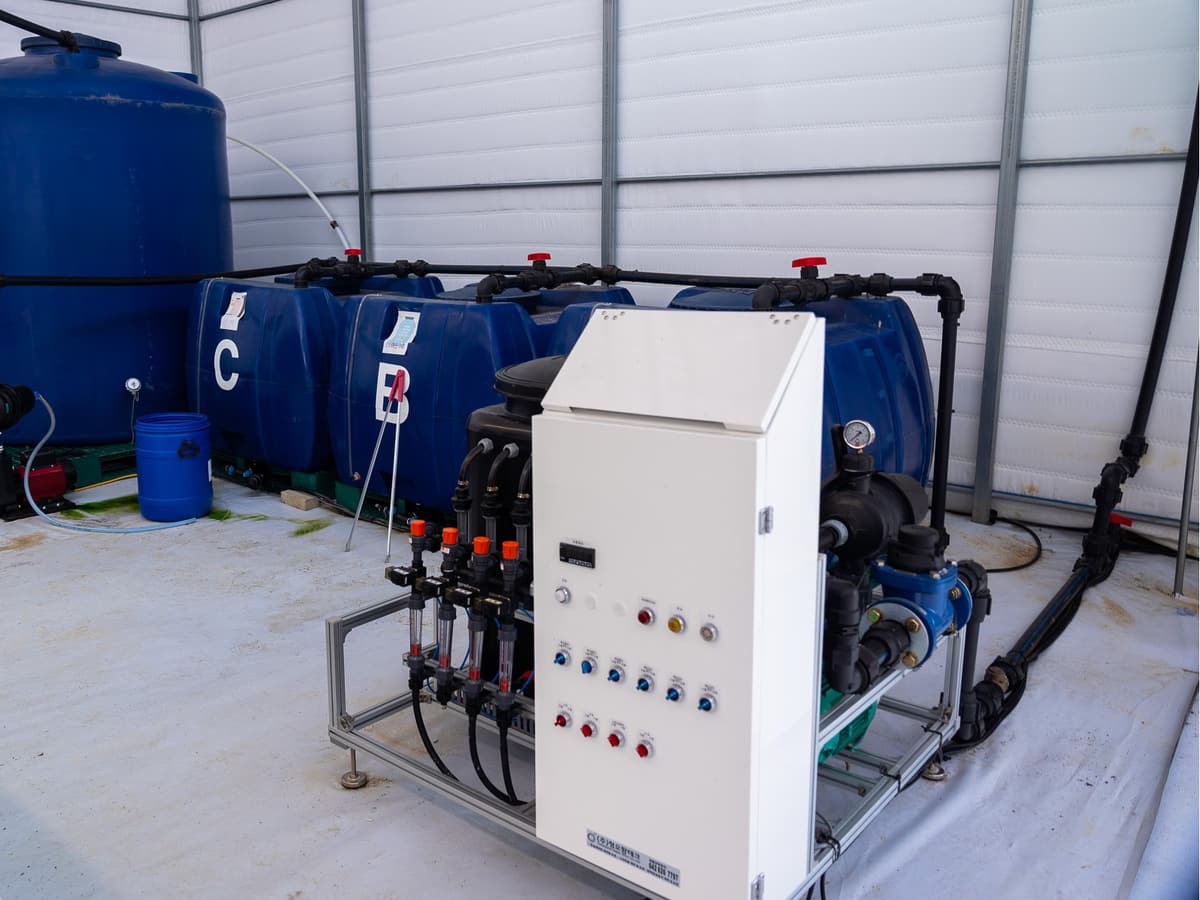
9Irrigation and nutrient solution equipment
- Role
- Water and nutrients mixed in the fertigation unit are distributed to each bed through pipes and drip hoses. Solenoid valves open and close the supply zone by zone.
- Why it matters
- Watering by hand gives each zone a different amount. Feeding set amounts evenly at set times keeps growth uniform from plant to plant, so the strawberries come out consistent in size and flavor. Less surplus solution also saves fertilizer and water.
WORKSPACE
Workspace · custom design
A greenhouse is where crops grow and where people work every day. We design the space and scale around how your farm operates.
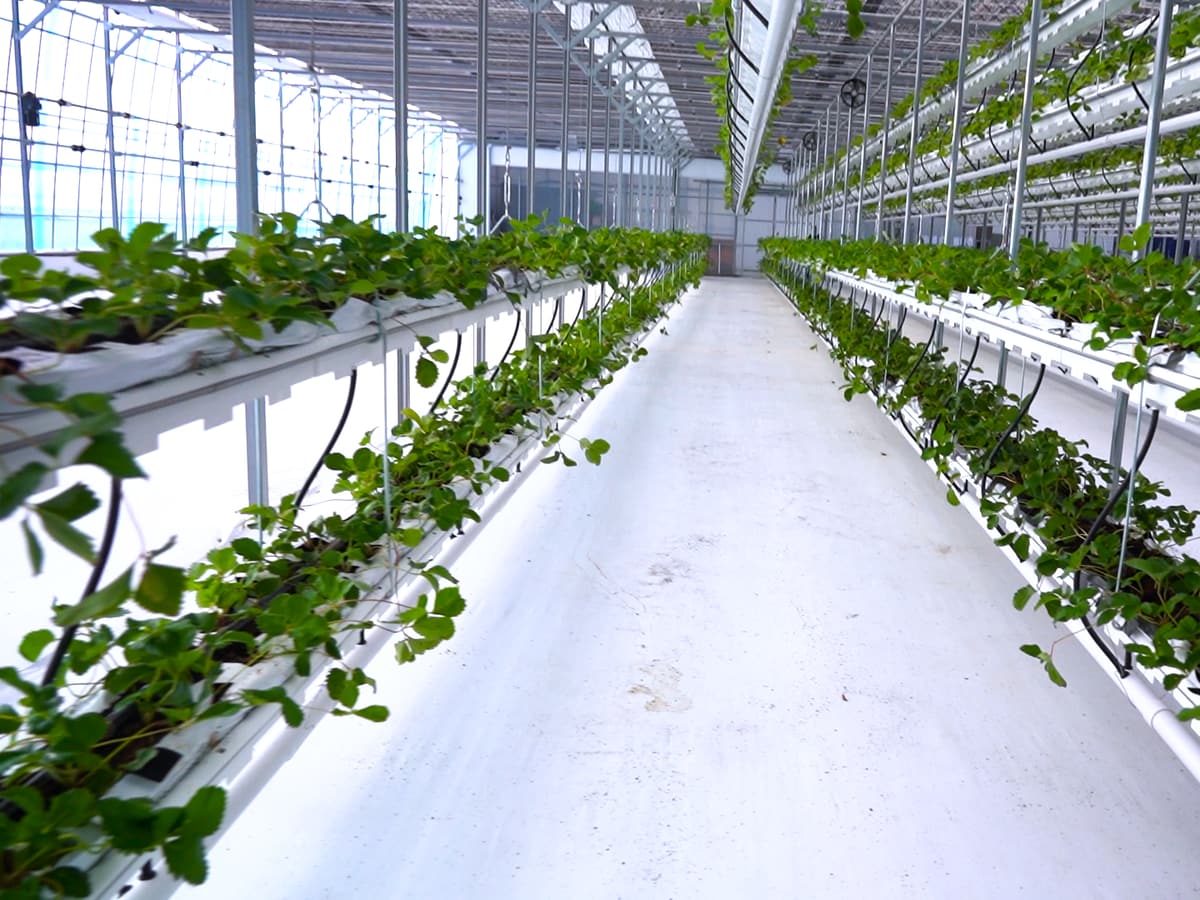
10Floor tarpaulin
- Role
- A waterproof, weed-blocking cover is laid over the entire greenhouse floor.
- Why it matters
- No weeds grow, and there is less dust and fewer puddles, so the greenhouse stays clean. Less moisture rising from the floor helps with disease control, and carts and workers can move around more easily.
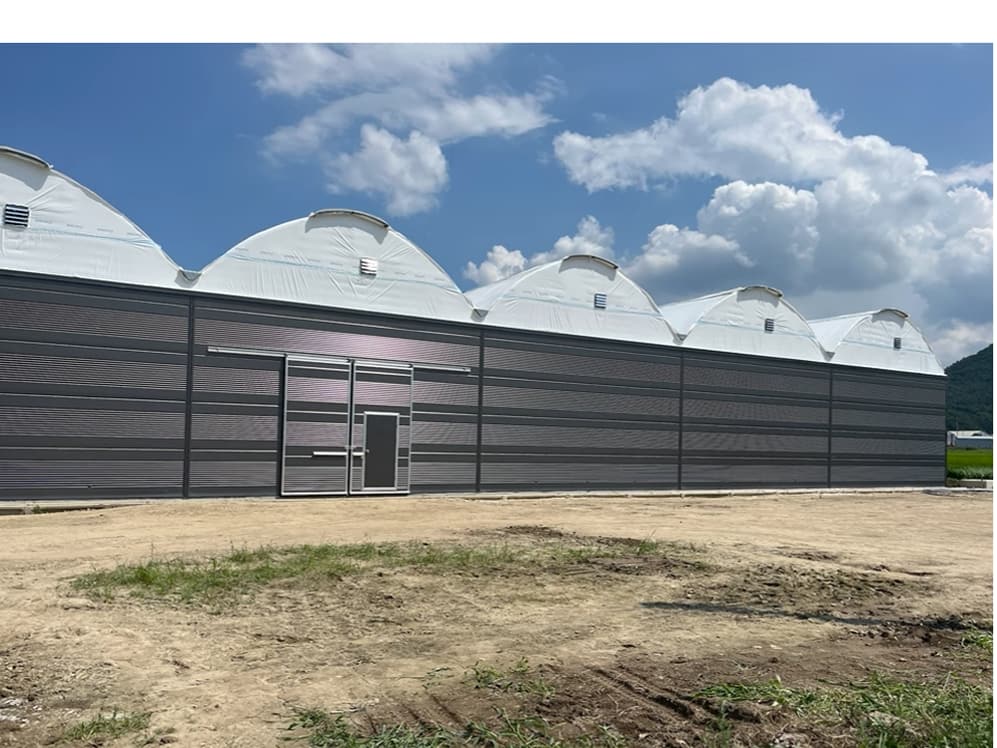
+Panel work building
- Role
- One end of the greenhouse is enclosed with sandwich panels to serve as a sorting area, materials storage, fertigation room, and break area.
- Why it matters
- Without a separate building, everything from harvesting to sorting and packing happens inside the greenhouse. A separate equipment room protects machinery from moisture and dust.
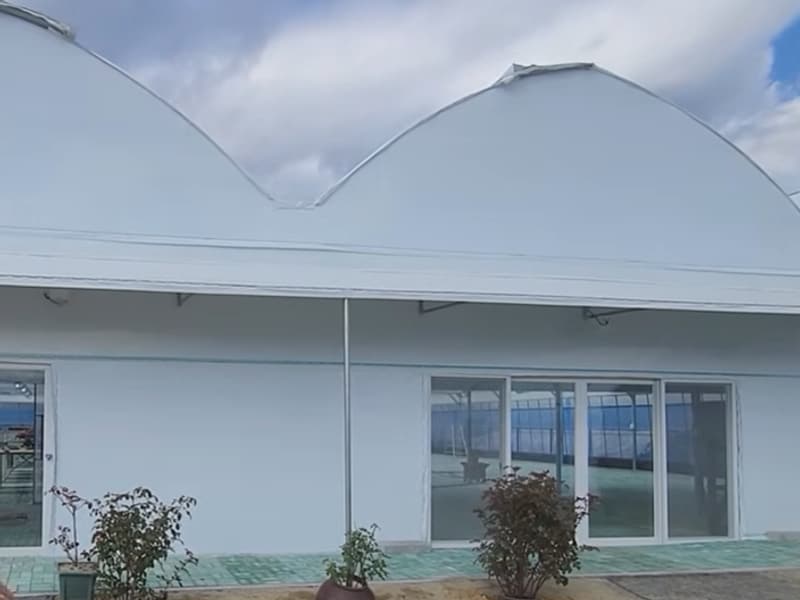
+Sash entrance door
- Role
- The front of the greenhouse is fitted with an aluminum sash entrance door.
- Why it matters
- It opens and closes easily and seals tightly, which helps with insulation and keeps insects out. It also improves the farm's first impression, which pays off especially if you run an agritourism farm or an on-site farm stand.
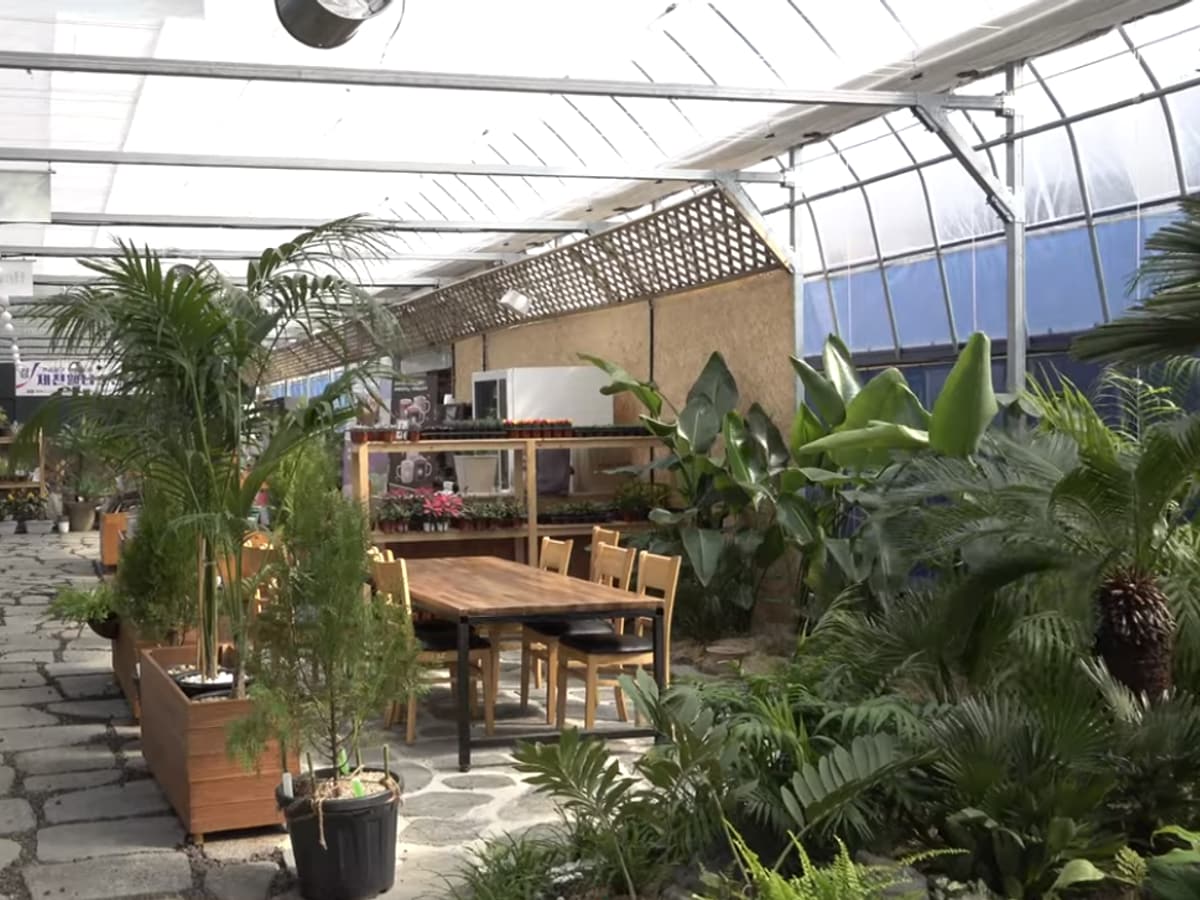
+Size and shape
- Role
- Single-span or multi-span, the width and height of the house, and the type of covering film are all chosen to suit the land and the crop.
- Why it matters
- Even for the same strawberry crop, the required height and frame spacing depend on whether you use tabletop beds or install the 2-Tier Hanging Bed. Designing the interior growing system from the start means less reinforcement later.
NEXT
Once the greenhouse is built,it's time to fill it
Dolsoe Smart Farm opens and closes on its own, and the 2-Tier Hanging Bed doubles the growing space in the same greenhouse. Design them together with the greenhouse, and everything comes together as one facility from day one.